
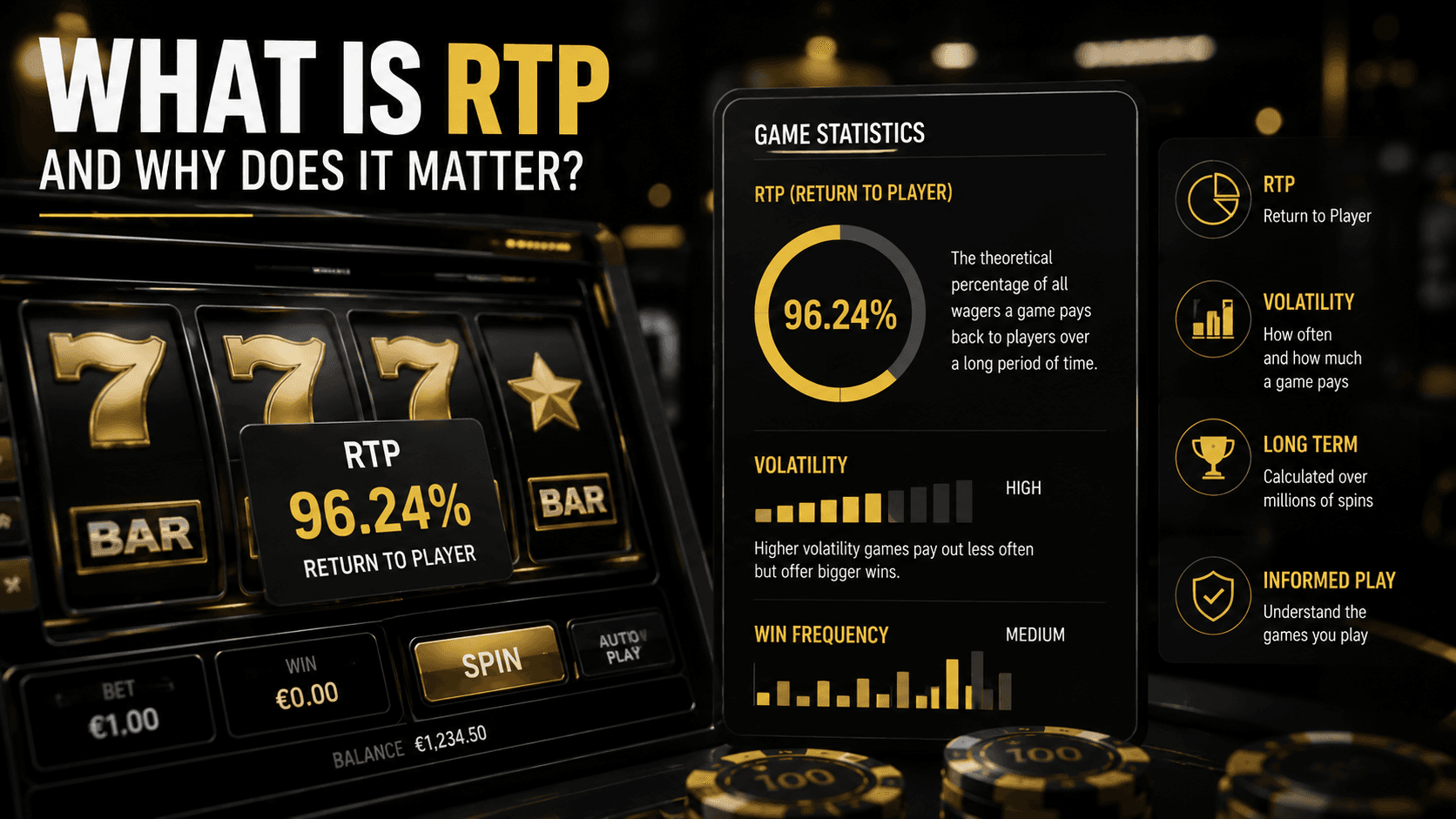
What Is RTP and Why Does It Matter in Online Casinos?
If you've ever looked at the information page of a slot game, you've probably seen a percentage labeled RTP.
For many players, it's just another statistic.
In reality, RTP is one of the most important numbers in online gambling because it helps explain how a game is designed to return money to players over time.
While RTP cannot predict individual results, understanding how it works can help players make more informed decisions when choosing games.
What Does RTP Mean?
RTP stands forReturn to Player.
It represents the theoretical percentage of wagered money that a game is expected to return to players over a very large number of spins or rounds.
For example:
If a slot has an RTP of 96%, the game is designed to return approximately €96 for every €100 wagered over the long term.
The remaining €4 represents the casino's mathematical advantage.
RTP Does Not Guarantee Results
This is where many players become confused.
A slot with a 96% RTP does not mean:
you'll get €96 back after betting €100;
you'll lose only €4;
every player receives the same results.
RTP is calculated across millions of spins.
Individual sessions can produce results that differ dramatically from the theoretical average.
A player might lose €100 quickly, while another could win a large jackpot during the same period.
Is A Higher RTP Better?
Generally, yes.
When comparing similar games, a higher RTP usually means the game is designed to return more money to players over time.
Example:
94% RTP = lower theoretical return
96% RTP = average modern slot
97%+ RTP = above-average return
However, RTP should never be viewed in isolation.
Another factor plays an important role.
RTP vs Volatility
Two games can have identical RTP values but feel completely different.
This is because RTP and volatility measure different things.
RTP
Shows the theoretical long-term return.
Volatility
Shows how winnings are distributed.
A high-volatility slot may pay less frequently but offer larger wins.
A low-volatility slot may provide smaller but more regular payouts.
This is why two 96% RTP slots can produce very different player experiences.
Where Can You Find RTP?
Most licensed game providers publish RTP information directly inside the game.
Players can usually find it by opening:
- Help;
- Paytable;
- Game Information;
- Rules.
Reputable casinos and software providers are generally transparent about RTP values.
If RTP information is difficult to locate, players should proceed carefully.
What Is Considered A Good RTP?
There is no perfect number, but many experienced players use the following guideline:
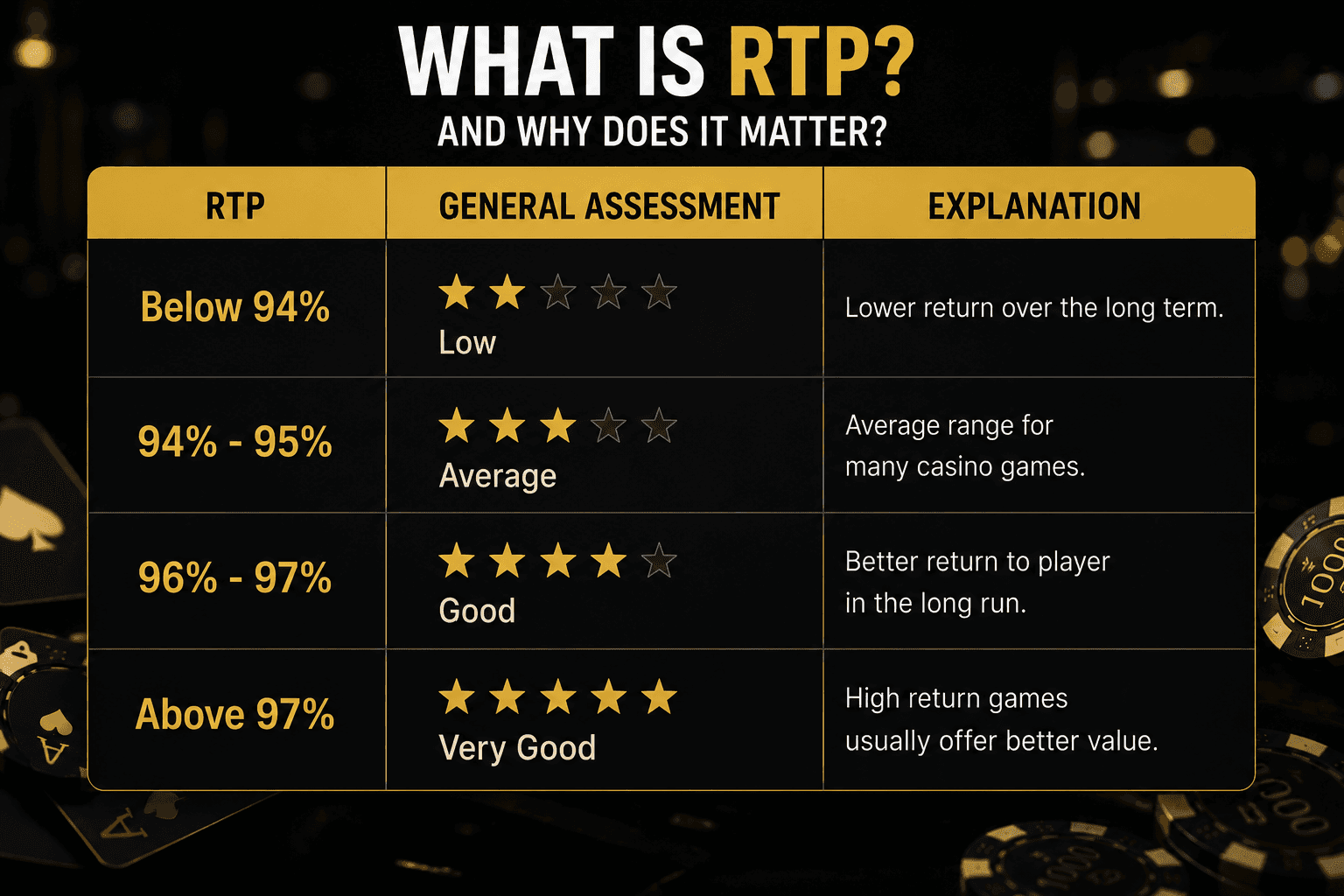
Many popular online slots operate around the 96% mark.
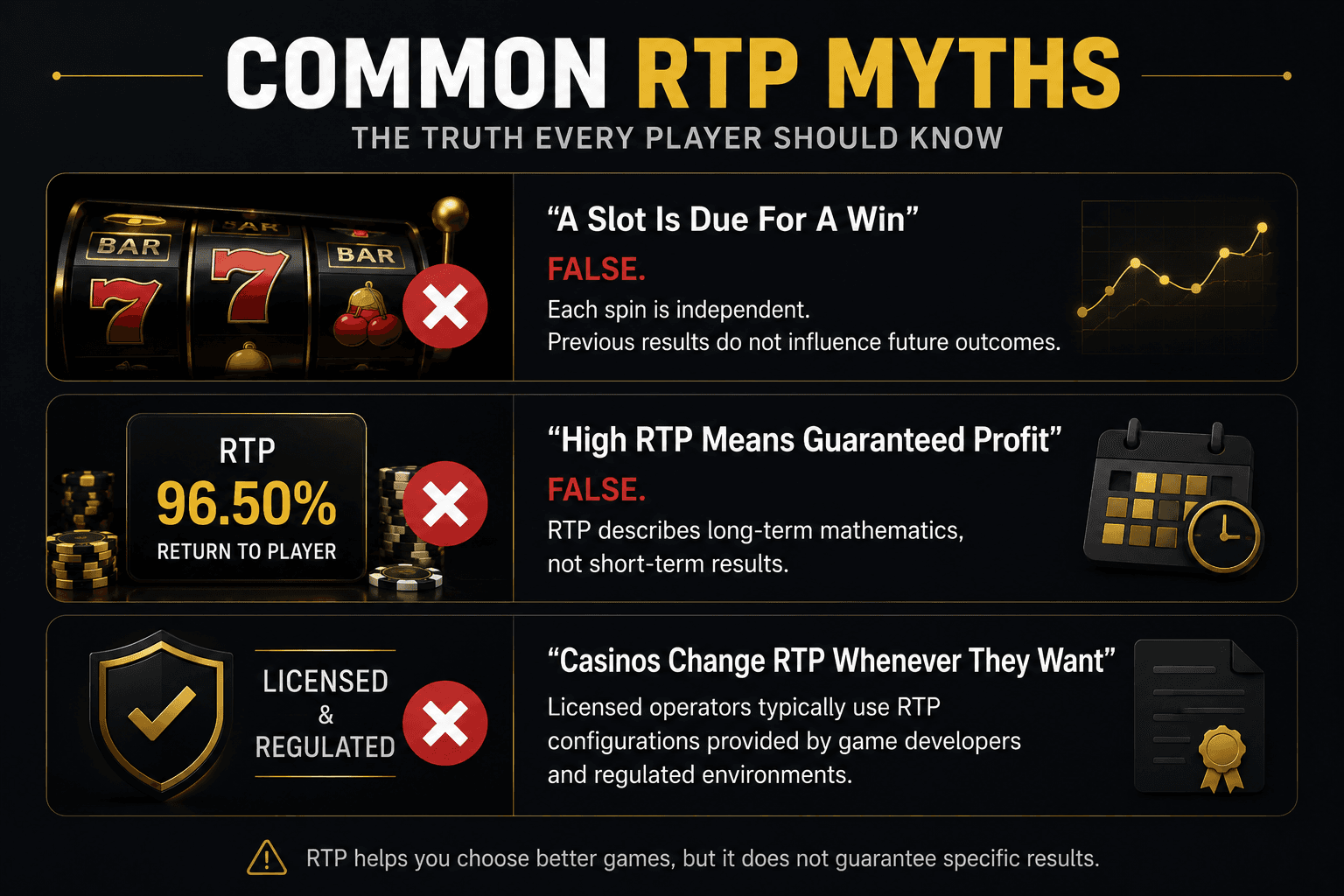
Common RTP Myths
Why RTP Matters
RTP will not help predict the outcome of your next spin.
However, it can help players:
compare games more effectively;
understand casino mathematics;
avoid low-return games;
make more informed decisions.
For anyone trying to understand how online casino games work, RTP is one of the first concepts worth learning.
Final Thoughts
RTP is not a strategy and it is not a guarantee of success.
It is simply a mathematical indicator that helps explain how a game is designed to perform over time.
While short-term results can vary significantly, understanding RTP allows players to evaluate games more intelligently and better understand the mechanics behind online casino gambling.
Common RTP Myths (explained)
Myth: A 96% RTP means you get €96 back every session
RTP is a long-run theoretical return across a huge number of spins — often millions in lab simulations. One session can finish far above or below 96%. Treat RTP as expected value over time, not a session refund rate.
Myth: RTP is set by the casino and can be faked in the UI
On reputable sites, RTP comes from the game supplier's certified math model and the configured game build. Prefer licensed operators and studios that publish RTP. If a site never discloses figures, treat that as a trust signal gap.
Myth: RTP changes based on time of day or how much you have won
Certified RNG games do not "tighten" after a win or overnight on legitimate platforms. Variance creates hot and cold streaks that feel personal; the underlying RTP configuration stays fixed for that game build.
Myth: Higher RTP removes the house edge
Even a 98% RTP game still has a 2% theoretical house edge. Higher RTP only shrinks that edge — it does not create a player advantage. Bankroll limits and session rules still matter.