
Why You Can't Use Someone Else's Payment Account at an Online Casino
Using a partner's card or a family member's e-wallet might seem like a simple way to make a casino deposit.
However, most online casinos require players to usepayment methods registered in their own name. The name on the casino account and the payment method usually needs to match.
But why is this rule so common, and what can happen if you ignore it?
1. Your payment method should match your casino account
When you create a casino account, your personal details become linked to your account.
The same principle applies to payments.
If your casino account is registered toAlex Brown, but the card belongs toSarah Brown, the casino can identify this as a third-party payment.
This applies to different types of payment methods, including:
- debit and credit cards
- bank accounts
- e-wallets
- some mobile payment services
- other personal payment accounts
Many operators explicitly require the payment method to be registered in the player's own name.
2. It helps prevent fraud
Payment ownership is an important part of casino security.
If players could freely deposit using other people's cards and accounts, it would be much harder for casinos to determine who controls the funds.
Matching account and payment details helps operators identify potential:
- unauthorised transactions
- stolen payment methods
- fraudulent activity
- suspicious transactions
- account sharing
That's why payment ownership can become part of the casino's security checks.
3. The problem may appear when you withdraw
A third-party deposit might not always be noticed immediately.
The issue can become more obvious when you request a withdrawal.
A casino may ask you to verify that the payment method belongs to you. Some operators can request documents or other proof of ownership during this process.
Depending on the casino's terms, a third-party transaction can result in:
- additional verification
- a delayed withdrawal
- the payment being reversed
- account restrictions
- cancellation of winnings connected to the payment
The exact consequences depend on the operator's terms.
4. What counts as a third-party payment?
It's not limited to using someone else's bank card.
A third-party payment can include:
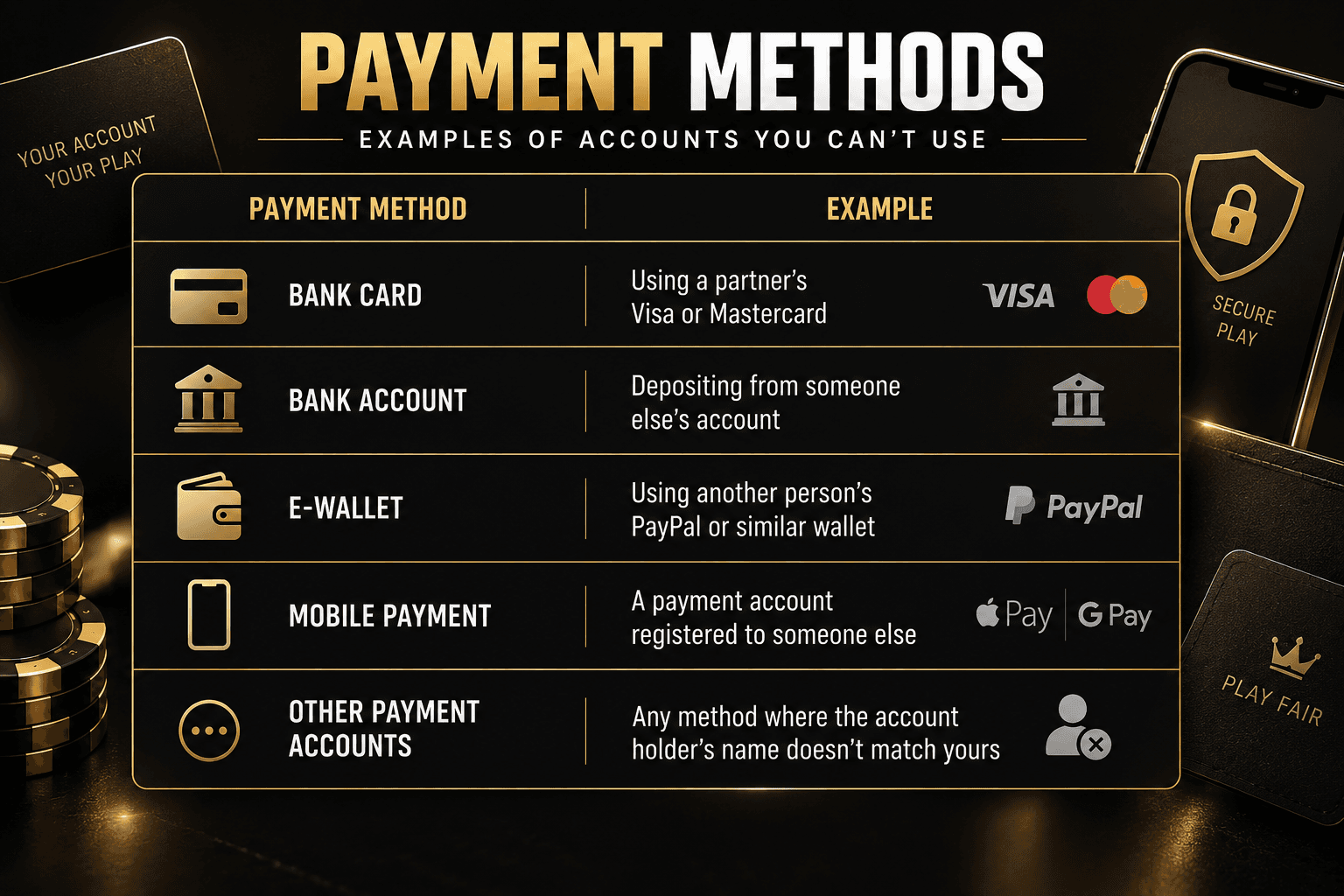
Even if the person has given you permission to use their payment method, the casino may still prohibit it.
5. What if you accidentally used someone else's payment method?
Don't continue making deposits with it.
The safest approach is tocontact the casino before making another transactionand explain what happened.
The operator may ask for documents confirming the payment method's ownership or provide instructions for resolving the situation.
Do not try to hide the transaction or create another account to get around the issue.
6. What about shared or joint accounts?
This can depend on the casino.
A joint bank account doesn't necessarily mean that every casino will automatically accept it as a valid payment method.
If the payment account contains more than one person's name, check the casino's payment terms or contact supportbefore depositing.
It's better to clarify this in advance than discover a problem when requesting a withdrawal.
Simple Payment Checklist
Before making a deposit, check these five things:
✓ The casino account is registered in your name
✓ The payment method is yours
✓ Your name matches the payment details
✓ The casino supports your chosen payment method
✓ You have checked the payment and withdrawal terms
Final takeaway
Using your own payment method is one of the simplest ways to avoid unnecessary problems with casino deposits and withdrawals.
A payment method may work technically even if it belongs to someone else — but that doesn't mean the casino allows it. Many operators explicitly prohibit third-party payments and can review transactions when ownership doesn't match.
The simple rule: your casino account, your payment method, your name.