
What Is Hit Frequency in Slots and Why Does It Matter?
What Is Hit Frequency in Slots and Why Does It Matter?
When comparing online slots, you'll often seeRTPandvolatilitylisted next to the game. Another number can appear in the game's specifications:hit frequency.
It sounds straightforward, but it's easy to misunderstand.
Hit frequency tells youhow often a game produces a qualifying winning outcome over a large number of rounds. It doesn't tell you how much you'll win, whether you'll finish a session in profit, or when the next win will happen.
Hit Frequency in One Example
Suppose a slot has a theoretical hit frequency of25%.
That means the game's mathematical model produces a qualifying hit on roughly 25 out of 100 spins over a sufficiently large sample.
It doesnotmean:
Spin 1–4 = one guaranteed win.
You could get several hits close together or go through a much longer sequence without one. Each spin remains an independent outcome.
The figure is about thelong-run pattern, not a schedule for individual spins.
A “Hit” Doesn't Always Mean Profit
This is probably the most important detail.
A hit can be a payout that'ssmaller than the original stake.
For example:
Stake: €1
Payout: €0.40
The game may count that as a hit because it produced a qualifying payout.
But your balance has still decreased by €0.60.
So a slot with a high hit frequency isn't automatically more generous or more profitable.
Hit Frequency vs RTP vs Volatility
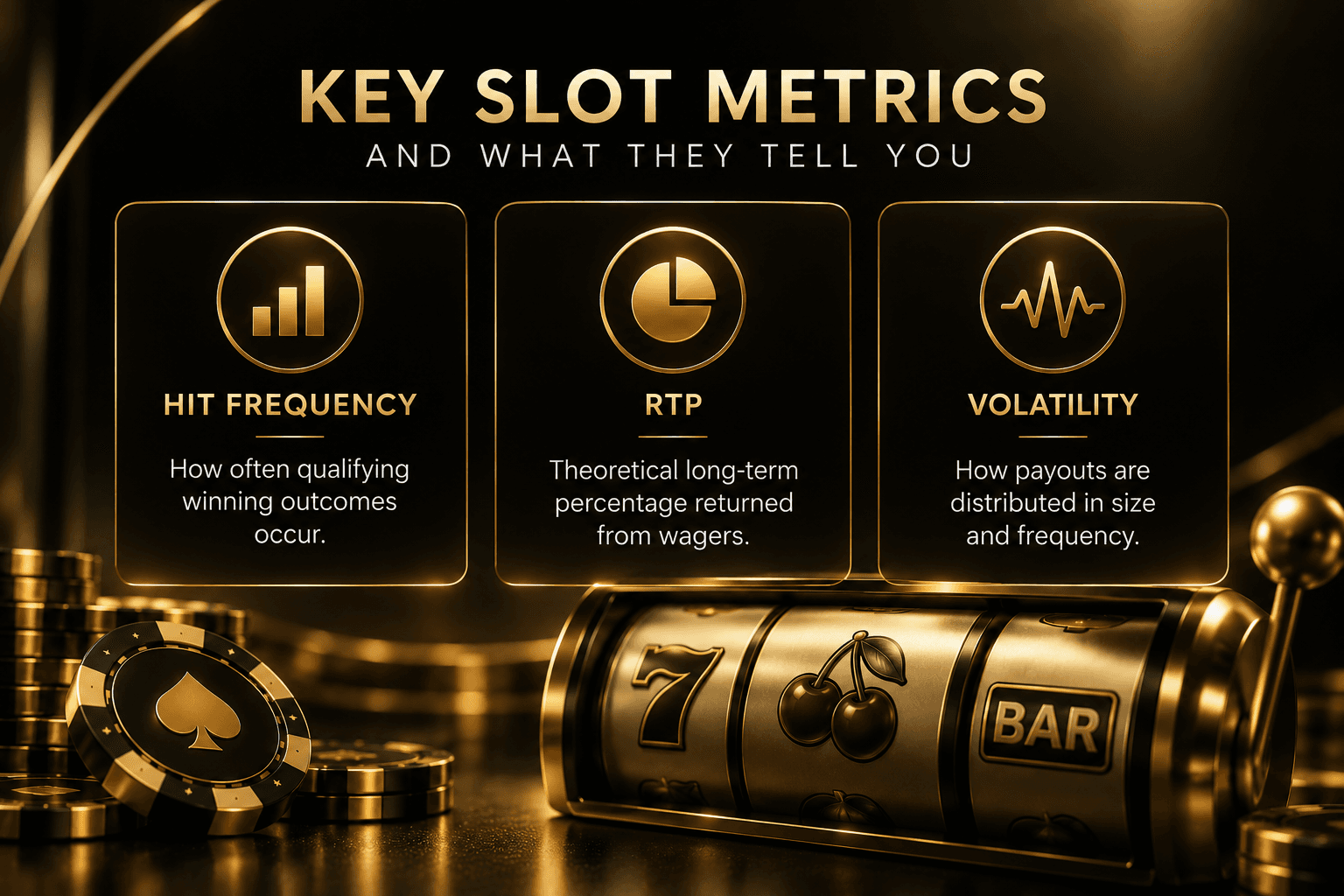
These three metrics describe different parts of a slot's mathematics.
Consider two hypothetical games:
Slot A:96% RTP + frequent smaller hits
Slot B:96% RTP + less frequent, larger hits
They can have the same theoretical RTP while producing a very different playing experience.
That's because RTP doesn't tell youhow the returns are distributed. Hit frequency gives you another piece of that picture, while volatility describes the broader payout pattern.
Why Hit Frequency Can Be Useful
Imagine you're looking at two games and both have a similar RTP.
One produces qualifying hits relatively often. The other has longer stretches without a hit.
The first may feel more active, while the second can feel much more unpredictable.
That doesn't make one mathematically "better." It simply means the games distribute their outcomes differently.
For players comparing games across European casino sites, hit frequency can therefore be useful asa way to understand the rhythm of a game, alongside RTP and volatility.
Where Can You Find Hit Frequency?
Unlike RTP, hit frequency isn't displayed consistently across every casino or game.
You may find it in:
- the game's information menu;
- provider documentation;
- mathematical specifications;
- testing documentation;
- specialist game databases.
If a casino doesn't publish the figure, don't try to calculate it from a short personal session. A few hundred spins aren't enough to reliably establish a game's theoretical hit frequency.
Does a Higher Hit Frequency Mean a Better Slot?
Not necessarily.
A higher number simply means that qualifying hits occur more frequently in the game's mathematical model.
It doesn't tell you:
- how large those hits are;
- how much the game returns overall;
- whether a spin will be profitable;
- when the next hit will occur.
In fact, a game can produce frequent small payouts while still having a relatively high house edge.
That's why looking athit frequency alonecan give you an incomplete picture.
What Should You Check Before Playing?
If the information is available, look at these figures together:
RTP— long-term theoretical return.
Hit frequency— how often qualifying hits occur.
Volatility— the general distribution of payout sizes.
Maximum win— the game's stated upper payout limit.
Game mechanics— bonus rounds, multipliers, cascades and other features.
Together, these give you a much clearer idea of what you're actually looking at than any single statistic.
Final Takeaway
Hit frequency tells you how often a slot is mathematically designed to produce a qualifying hit — not how much you'll win.
A high hit frequency can mean more frequent payouts, but some of those payouts may be smaller than your original stake.
For European players comparing slots, the useful approach is to readhit frequency, RTP and volatility togetherrather than treating any one number as a measure of whether a game is "good."